
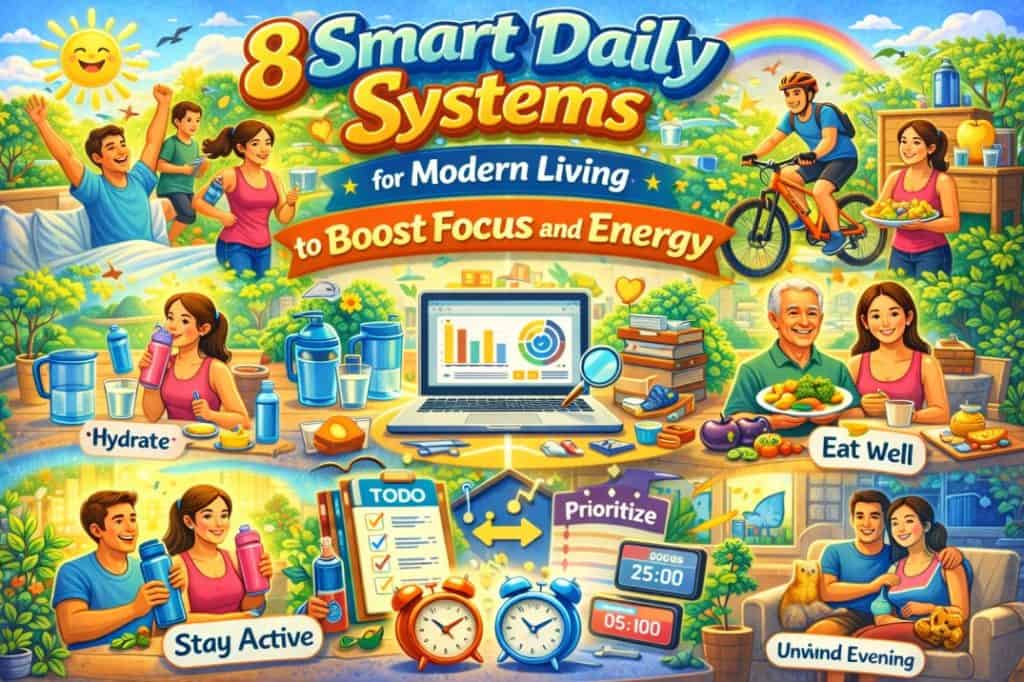

In a world that never slows down, staying focused and energized can feel almost impossible and Boost Focus and Energy. Notifications constantly demand your attention, your to-do list keeps growing, and by the end of the day, you’re mentally drained for Modern Living.
But here’s a powerful truth:
You don’t need more motivation-you need better systems.
Highly productive and mentally strong people don’t rely on willpower alone. They build smart daily systems that make focus and energy automatic for Modern Living. These systems reduce decision fatigue, eliminate distractions, and create a structure that supports your success to Boost Focus and Energy.
In this guide, you’ll discover 8 smart daily systems for modern living to boost focus and energy-simple, powerful, and life-changing strategies you can start today.
What Are Smart Daily Systems for Modern Living?
Smart daily systems are intentional routines and habits designed to optimize your time, mental clarity, and physical energy for Modern Living. Instead of reacting to your day, you design it.
These systems help you:
- Stay consistent without burnout
- Reduce stress and overwhelm
- Improve productivity effortlessly
Think of systems as the foundation of a focused, energized life.
1. The Powerful Morning Reset System to Ignite Focus and Energy

Your morning is your launchpad.
A rushed, chaotic start leads to scattered thinking for Modern Living. But a calm, intentional morning creates clarity and control to Boost Focus and Energy.
A powerful morning reset system includes:
- Hydration (wake up your body)
- Light movement (activate energy)
- Quiet time (calm your mind)
This simple system prepares your brain before the world starts demanding your attention Boost Focus and Energy. Avoid your phone for the first 30 minutes-protect your mental space.
2. The Laser-Focused Priority System That Eliminates Overwhelm

Most people fail not because they do too little-but because they try to do too much.
A smart priority system helps you focus on what truly matters to Boost Focus and Energy.
Instead of overwhelming to-do lists, choose:
3 high-impact tasks per day
This system:
- Sharpens your focus
- Reduces mental clutter
- Increases productivity
What are the 3 most powerful tasks I must complete today?
3. The Proven Time-Blocking System for Maximum Focus and Energy
Multitasking is the enemy of focus and Boost Focus and Energy.
Time blocking is a proven productivity system where you divide your day into focused segments.
Example:
- Deep work (no distractions)
- Admin tasks
- Breaks
This system:
- Eliminates distractions
- Improves efficiency
- Protects your energy
When you focus on one task at a time, your brain performs at its peak for Modern Living.
4. The Energizing Movement System That Fuels Your Body and Mind

Sitting for long hours drains your energy faster than you think for Modern Living.
A movement system ensures your body stays active-even on busy days.
Simple but powerful actions:
- Walk after meals
- Stretch every hour
- Take short activity breaks
This system:
- Boosts circulation
- Improves mental clarity
- Reduces fatigue
Movement is a natural energy booster-use it daily.
5. The Smart Nutrition System for Stable Energy and Sharp Focus
What you eat directly impacts how you feel for Modern Living.
A smart nutrition system focuses on consistent, balanced energy instead of quick fixes.
Include:
- Protein (sustained energy)
- Complex carbs (steady fuel)
- Healthy fats (brain function)
Avoid:
- Sugar spikes
- Heavy processed foods
Stable blood sugar = stable focus.
6. The Digital Detox System to Reclaim Your Attention

Your attention is your most valuable asset-and it’s constantly being stolen for Modern Living.
A digital detox system helps you take control and Boost Focus and Energy.
Try:
- Turning off unnecessary notifications
- Scheduling screen-free time
- Limiting social media
This system:
- Reduces mental overload
- Improves concentration
- Restores clarity
You don’t need to disconnect completely-just use technology intentionally.
7. The Mental Reset System for Instant Clarity and Energy
Your brain is not designed to work non-stop.
A mental reset system helps you recharge during the day.
Simple methods:
- Deep breathing
- Short walks
- Stepping away from screens
Even a few minutes can:
- Reduce stress
- Improve focus
- Restore energy
Breaks are not weakness-they’re strategy.
8. The Night Reflection System for Continuous Growth and Focus

Your day doesn’t end when work stops-it ends when you reflect.
A reflection system helps you:
- Learn from your day
- Plan better
- Reduce stress
Ask yourself:
- What went well today?
- What can I improve?
- What am I grateful for?
This system creates:
- Clarity
- Confidence
- Better decision-making
Reflection turns experience into growth to Boost Focus and Energy..


